The Colours of Roztocze
draft MT — needs author review
… and then the air pierced us, trembling with the rhythmic, heavy clatter of a freight train rolling past. Before we understood what it was, the rust-brown monsters had already been swallowed back into the calm of Roztocze’s green country.
Then came silence… A silence that soothed every unease. The worlds we had brought with us, ordered to the ticking rhythm of great cities’ clocks, dissolved in an instant like soap bubbles. Hungry thoughts greedily seized the reality around us, which slowly filled souls so aching. Souls thirsting for landscapes wrapped in the scent of chamomile, cornflowers, poppies, and views where tall hills covered in the golden ochre of grasses give birth to trees — trees that watch at night for falling stars.
And those butterflies too, immersed in a trembling palette of colours… As some say, fragile and delicate as they are, it is they who, with the trembling of their wings, summon a good wind…
That is how the 8th International Painting Plein-Air “Colours of Roztocze” began in Zwierzyniec, running from the 7th to the 19th of July 2014 — and neither it, nor the changed people we became, would have existed without our patrons of the arts: the City Office of Tomaszów Lubelski — Mayor Wojciech Żukowski, the District Office of Tomaszów Lubelski — District Governor Jan Kowalczyk.
The whole undertaking was organised by the Tomaszów Cultural Centre, with the irreplaceable Ms Marzena Mazurek-Jędrak serving as commissioner.
Our base for the plein-air was the Zacisze Centre in Zwierzyniec, filled with a warm and welcoming atmosphere, providing everything an artist could need — from morning coffee accompanied by birdsong, to wonderful meals, unrepeatable landscapes, workspace, and a sky raining stars.
Somewhere out there, under those stars, you can see by day what rustles so in Szuściec. Past the cottages, past fields of poppies, where the brush of a butterfly’s wing cools the face, some important lord is said to have downed a great jug, the road to him leading over water-steps. So off we went. All together — Wiktor, Jarosława and Tamara from Ukraine, Rytis leaning in from Lithuania, Jegor and Wiktoria from Belarus, one German, Wiebke, and after her, only Poland was left — Marzka, Jerzy and Irmina, three Krzysztofs, and finally, rummaging in the grain, Andrzej, recalling the colours of Roztocze along with Nela. What a place this land is! Proudly, noisily, life flows with the water through the thickets. And we, so small, lost, are unlikely to find its source. Time to head for Zamość! Someone shouted from behind a willow — off we go, then!
The old town, the cathedral, crowds of people, the restored Synagogue. Encircled by the remnants of the fortifications, full of admiration for all the city has preserved, here, beneath its monument, we bow our heads. Little time left, so on to the Devil’s Fields. And we are already in the misty valley between Karczmisko and Hamernia, where an old cottage has collapsed along with its chimney. Here, where by night, by the fire, to the rhythm of violins, the devils’ dances end at dawn. A shiver runs through us, someone screams somewhere, so quickly now, while there’s still time, while it’s still evening, on to Tomaszów Lubelski.
Caught in the morning sun before the figure of St Thecla, we are soon freed — not entirely — from the plague, further down Lwowska to see all the monuments. Old wooden houses, a tea house, an Orthodox church, there is a tomb, and a larch-wood church in baroque splendour. Later, tracing the last rays before they fade, having earlier set the poppies aglow in the water, following the Cossack to the Palace in Narol, once home to the Potocki family, today its gates stand open for artists.
And in the Wieprz Valley we were driven on to Guciów, made to enter the homestead. Roofs thatched with straw, mallows beneath the windows shielded by a ladder-wagon, pegs in the fence drying pots, bellows roaring after the smith, some forgotten quern abandoned by the well — no grinding today, but once it must have smelled of grain. With that scent of bread still in memory, we find ourselves in the Avenue of Oaks at Górecko Kościelne. Monumental trees, 500 years old, remind us what children of this earth we are. Nature towers above, and ahead of us still lies the road to Babia Dolina among the quarries, but first we must reach Józefów.
And with this journey I close the tale of this land — of the storks at Górecko Kościelne, of daisies, of lost apples, of its charms, of devils, of the magic stream. Time ticks on for us, relentless; it is time to head home, perhaps to meet again some joyful morning next year.
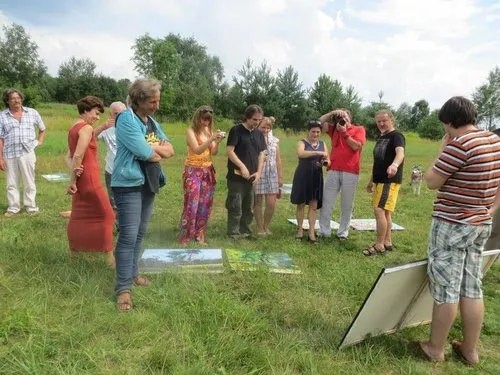
8th International Painting Plein-Air “Colours of Roztocze,” Zwierzyniec, 7–19 July 2014.